Deep dive 3 min read
Hagfish Slime: How It Works (and Why Scientists Love It)
A hagfish can turn the water around it into a bucket of slime in less than half a second – and the threads inside are so strong that scientists want to make clothes from them. Here's how hagfish slime works.
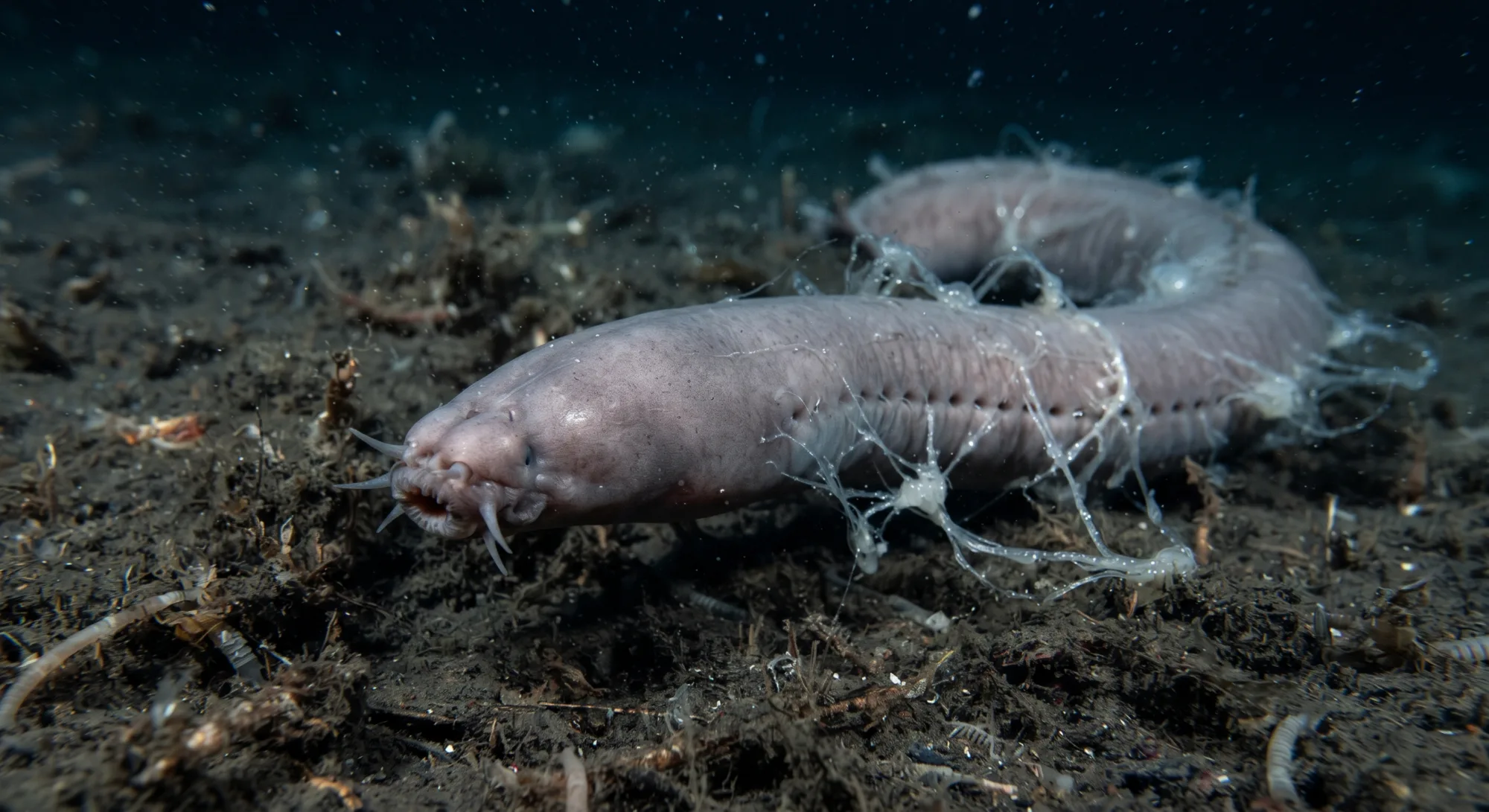
The hagfish looks harmless: a pale, floppy tube with no jaws and no scales. But try to bite one and you’ll get a mouthful of the most impressive defence in the ocean – instant slime. Lots of it.
How does hagfish slime work?
A hagfish has a row of slime pores along each side of its body – more than 100 in some species. When it’s grabbed or attacked, it squirts a small amount of concentrated slime from these pores. The moment it touches seawater, it explodes in volume, turning into a thick, stringy goo that fills the water around the fish. The whole thing happens in less than half a second.
Why doesn’t the slime just wash away?
Because it’s reinforced. Hagfish slime contains two key ingredients: mucus, and thousands of incredibly fine protein threads, each thinner than a human hair. The threads are tightly coiled inside special cells, like a ball of yarn. In seawater they unravel and form a tangled net that traps water and holds the mucus together. That’s what makes hagfish slime so thick and stringy instead of watery.
Mucus plus microscopic ropes. It’s basically slime with a skeleton.
What does the slime do to predators?
It clogs their gills. When a shark or other fish bites a hagfish, its mouth and gills fill with slime, and it can’t breathe properly. Underwater videos show predators backing off and spitting the hagfish out, gagging. Sharks have learned to leave hagfish alone.
How does a hagfish get rid of its own slime?
With a party trick: the hagfish ties its own body into a knot and slides the knot from head to tail, scraping the slime off. If slime gets into its single nostril, it sneezes it out.
Could we use hagfish slime?
Scientists think so. The threads in hagfish slime are remarkably strong and stretchy – they can stretch almost as far as spider silk before breaking. Researchers have been studying them as a possible natural alternative to plastic-based fibres for fabrics. A biochemist working for the US Navy has even recreated the slime proteins in the lab using bacteria, with ideas ranging from protective materials to packaging and parachutes.
Strange but trueIn 2017, a truck carrying about 7,500 lb (3,400 kg) of live hagfish overturned on a highway in Oregon. The road – and several cars – ended up buried in slime.
Sources
Tell a friend