Deep dive 3 min read
Komodo Dragon Bite: Is It Venomous?
For decades, people said Komodo dragons kill with deadly bacteria in their mouths. Then scientists found venom glands. Here's how a Komodo dragon bite really works – and how dangerous it is to humans.
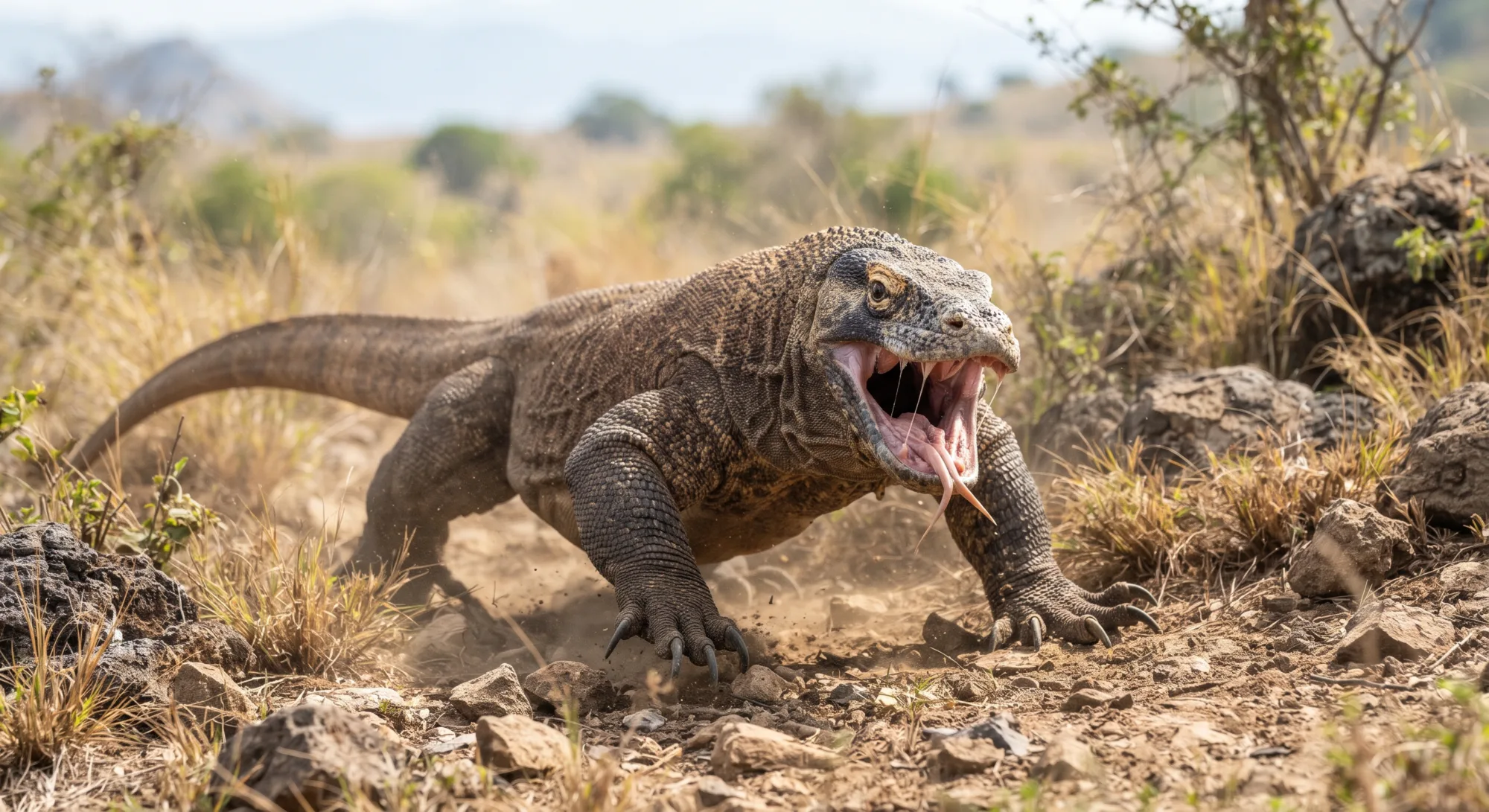
The Komodo dragon is the biggest lizard on Earth, and its bite has a terrifying reputation. For a long time, the story went that its mouth was full of deadly bacteria and a bitten animal would slowly die of infection. The real story is different – and arguably scarier.
Is the Komodo dragon venomous?
Yes. In 2009, a team of scientists scanned a Komodo dragon’s head with an MRI scanner and found large, complex venom glands in its lower jaw, with ducts that open between the teeth. Tests of the venom showed a cocktail of toxins that stop blood from clotting and make blood vessels widen. That combination makes a wounded animal bleed heavily and its blood pressure drop.
What about the deadly bacteria?
That’s the old theory. The idea was that bacteria from rotting meat in the dragon’s mouth caused fatal infections in its prey. The scientists who discovered the venom argued that bacteria aren’t the main weapon – no single dangerous species is consistently found in all dragons, and the venom explains why bitten animals go into shock so quickly. Some researchers still think bacteria might play a small role, but venom is now considered the key.
Not dirty mouth. Venom. The Komodo dragon’s reputation got an upgrade.
How strong is a Komodo dragon’s bite?
Surprisingly weak for its size. Computer models of its skull show that its bite force is much lower than a crocodile’s. But the skull is built to withstand strong pulling. Instead of crushing, the Komodo dragon uses a grip-and-rip technique: it bites, pulls back hard and tears open long wounds with its serrated teeth. In 2024, scientists discovered that the cutting edges of those teeth are coated with iron, keeping them razor-sharp.
How does a Komodo dragon hunt?
It ambushes. A dragon waits near a trail, then bursts out with a short sprint of up to about 20 km/h and bites. Big prey like deer or water buffalo may escape at first – but between the deep wounds, blood loss and venom, the dragon only has to follow and wait.
Is a Komodo dragon bite dangerous to humans?
Yes, but attacks are rare. Most dragons avoid people, and visitors to Komodo National Park always walk with trained rangers. Still, fatal attacks have happened: an eight-year-old boy was killed on Komodo Island in 2007, and a fisherman in 2009. Anyone bitten needs urgent medical care because of the deep wounds, blood loss and risk of infection.
Strange but trueOnce its prey finally goes down, a Komodo dragon can eat up to 80% of its own body weight in a single meal.
Want to know how big these dragons get? Read How Big Do Komodo Dragons Get?
Sources
Tell a friend