Skip to content
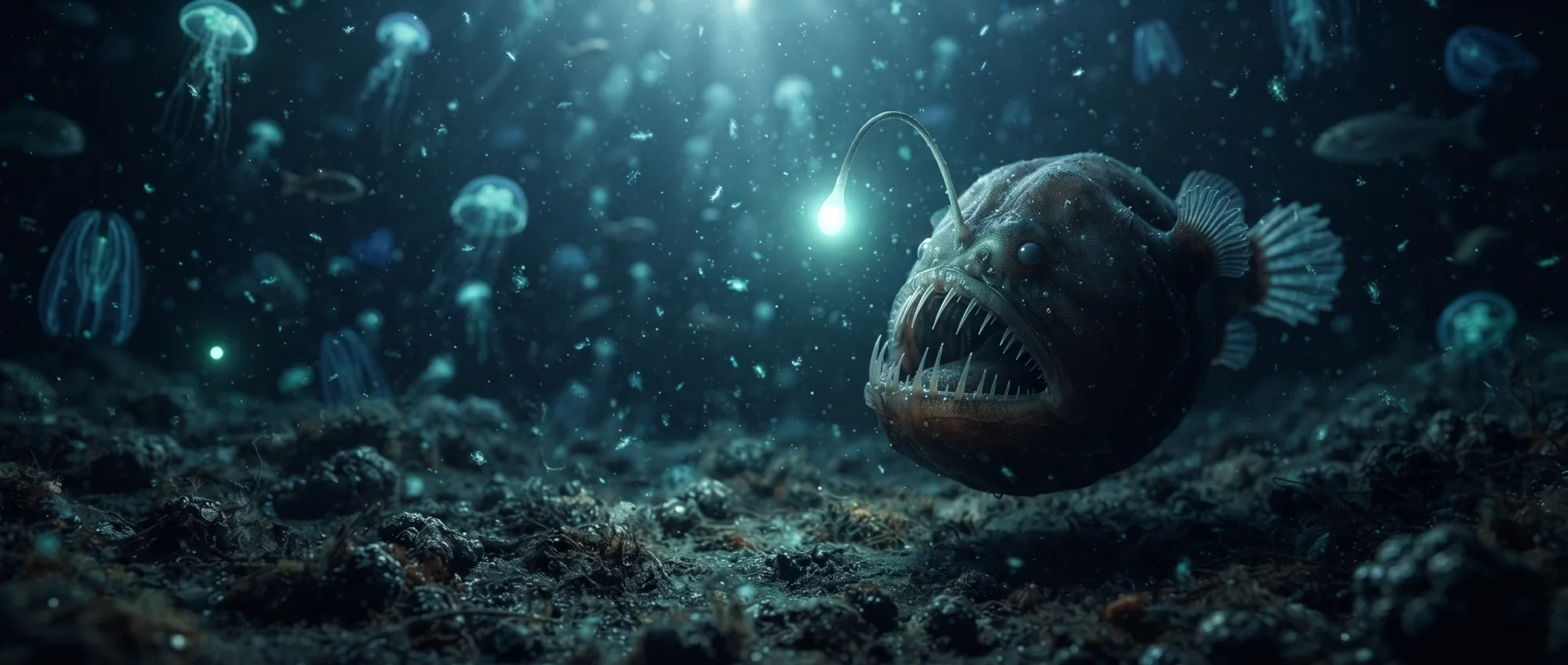
Anglerfish with a glowing lure hovering over the dark seafloor

Anglerfish: The Deep-Sea Fish With Its Own Lantern

Ceratioidei (deep-sea anglerfish, about 170 species)

Brings its own light to dinner

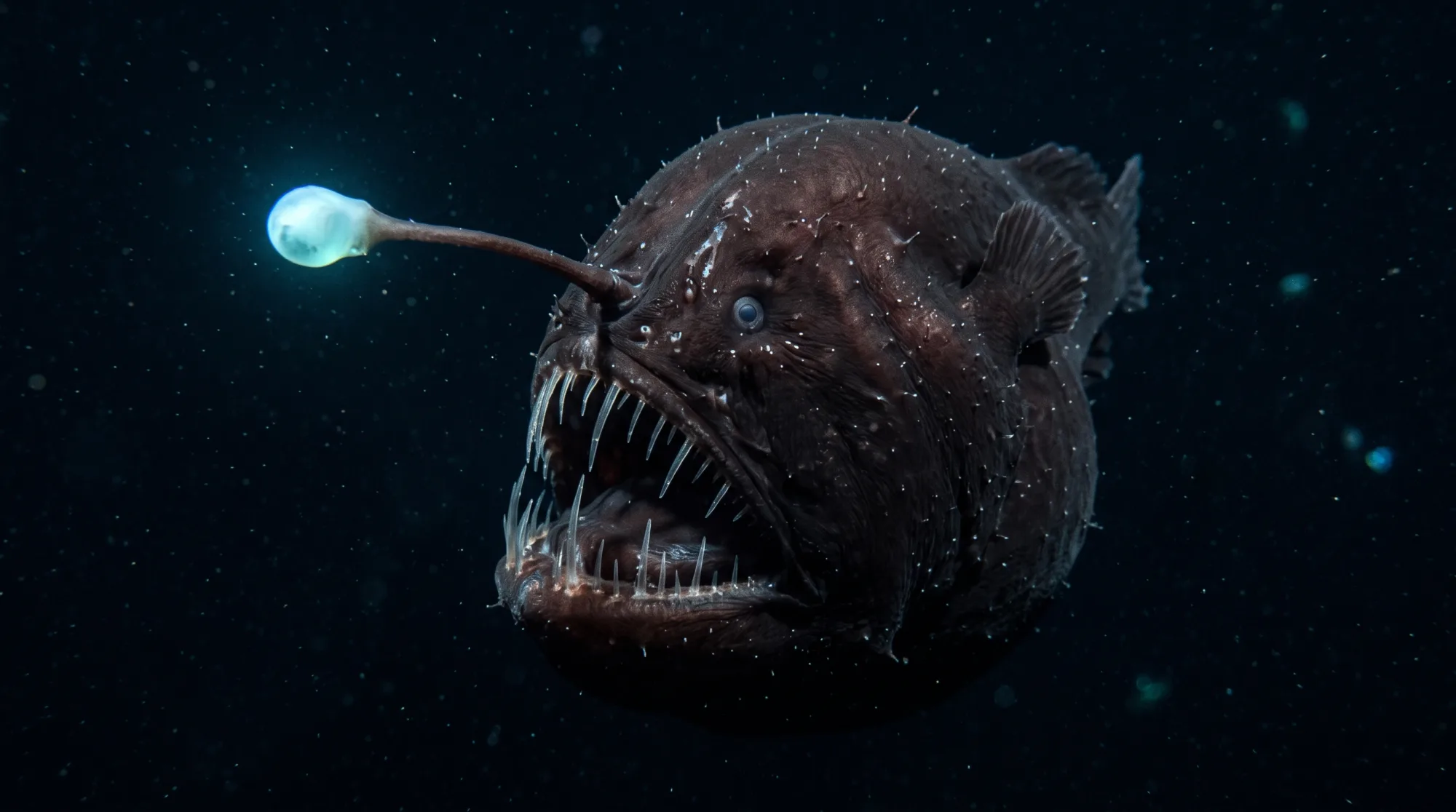
A mouth full of needle teeth and a glowing fishing rod growing out of its forehead. Deep-sea anglerfish don’t chase prey – they switch on a light in the pitch-black ocean and wait for something curious to swim too close. Their love life, by the way, is the strangest in the animal kingdom.

Anglerfish vs. you

Your height ft in5 ft 7 in

Quick facts

Size
Females range from a few cm to about 3 ft 11 in (1.2 m); males can be under 0.4 in (1 cm)
Left in the wild
Unknown
Unknown – they live too deep to count

Conservation status

Varies by species – most are too rarely seen to assess

Superpowers

  • Venomous : Is it venomous? No
  • Glows : Does it glow? Yes – the lure glows thanks to light-making bacteria
  • Regenerates limbs : Can it regenerate limbs? No

Identity

Scientific name
Ceratioidei (deep-sea anglerfish, about 170 species)
Class
Ray-finned fish

Life & family

Diet
Fish, squid and shrimp – sometimes bigger than the anglerfish itself
Gestation
None – they lay eggs
Predators
Few known – it’s a hard animal to find

Where to find it

Habitat
Open deep ocean, mostly below 980 ft (300 m)
Lives in
Every ocean
In the wild
No – only from a deep-sea submersible
In zoos
No – they don’t survive at the surface

Explore similar

Why is this animal unusual?

The “fishing rod” is a fin spine that moved to the forehead and grew a pocket of glowing bacteria on its tip. The anglerfish wiggles it like bait. When something comes to investigate, the jaws snap shut in a flash.

Why does it look like that?

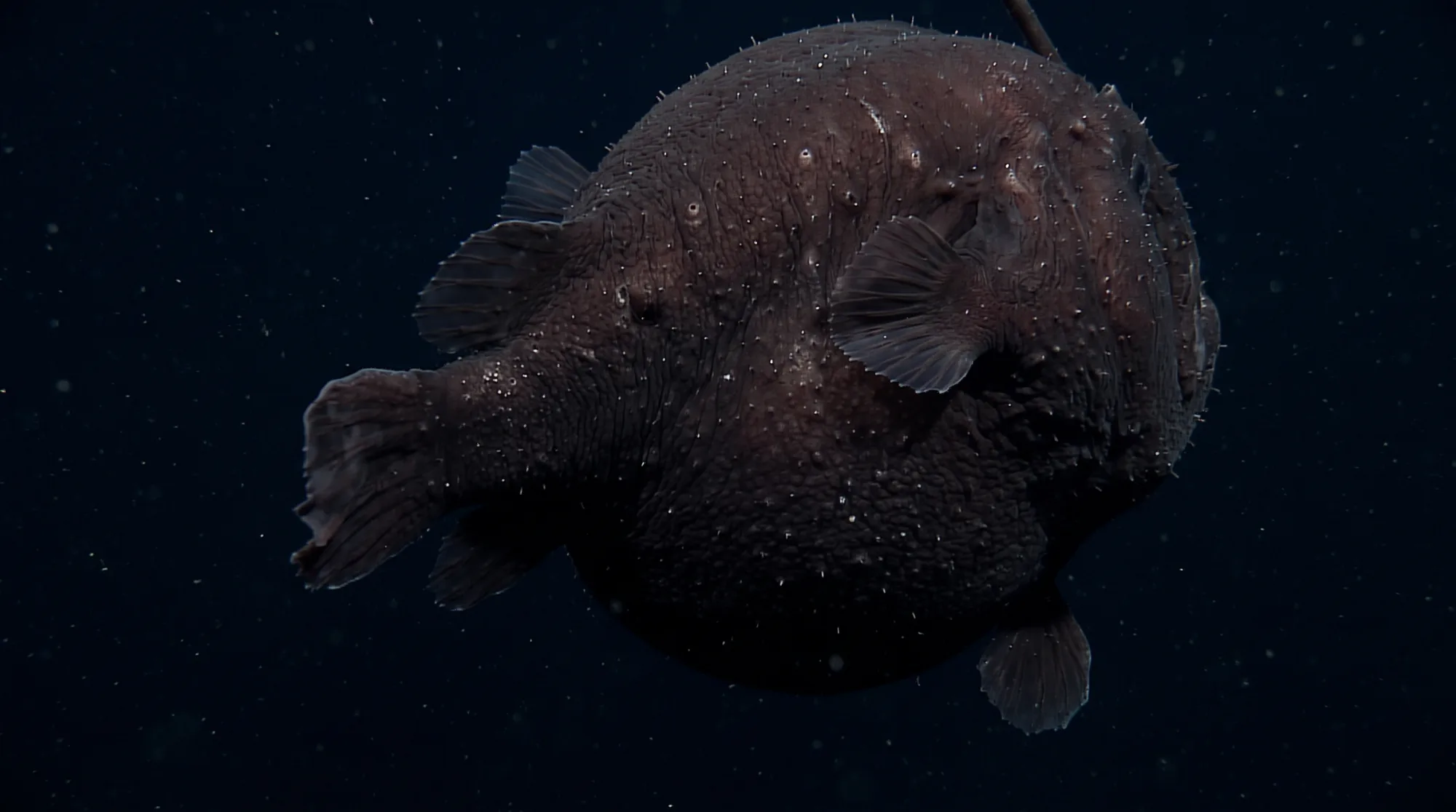
Food is rare in the deep, so an anglerfish is built never to miss a meal: a huge mouth, long teeth that fold inward and a stomach that stretches like a balloon. Some can swallow prey twice their own size.

Strangest biological feature

The lure. Only females have one, and each species has its own shape – a bit like a glowing name tag in the dark.

Why is it strange?

In some species the tiny male bites a female and never lets go. His body fuses with hers, their bloodstreams join and he shrinks into little more than a lump that makes sperm. One female can carry several males at once.

Interesting behavioral facts

Anglerfish barely swim. They hang motionless in the dark to save energy and let the lure do the work. Males have no lure at all – just enormous nostrils for sniffing out a female across the blackness.

Records held

The male of one species, Photocorynus spiniceps, is fully grown at about 0.2 in (6 mm) – one of the smallest backboned animals ever found. A living mated pair was first filmed only in 2016.
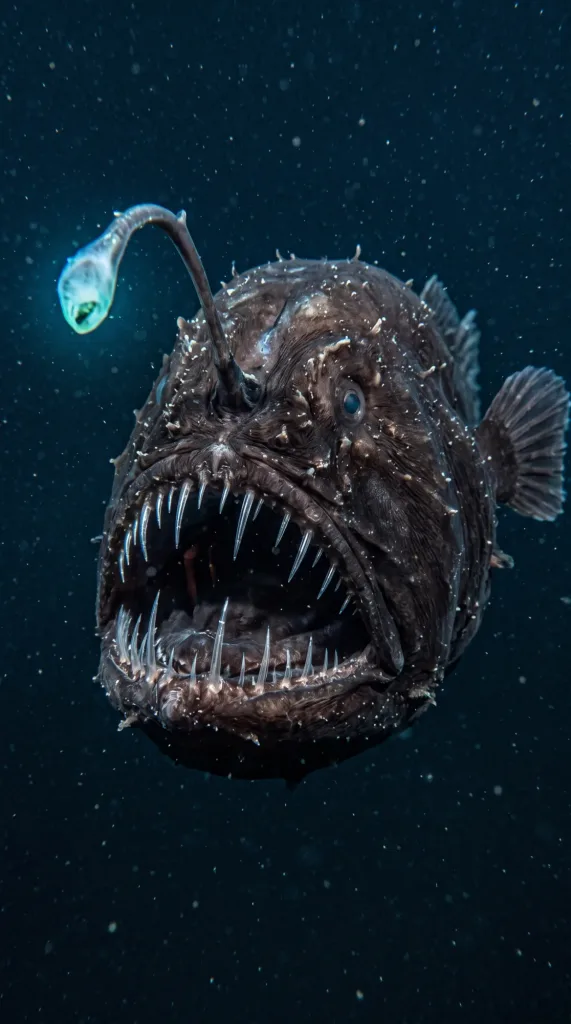
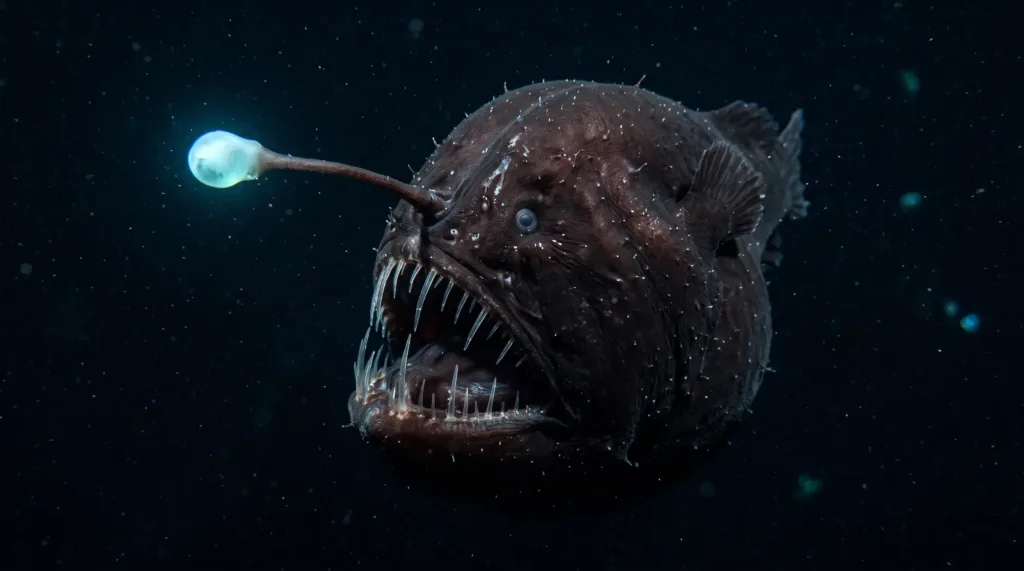
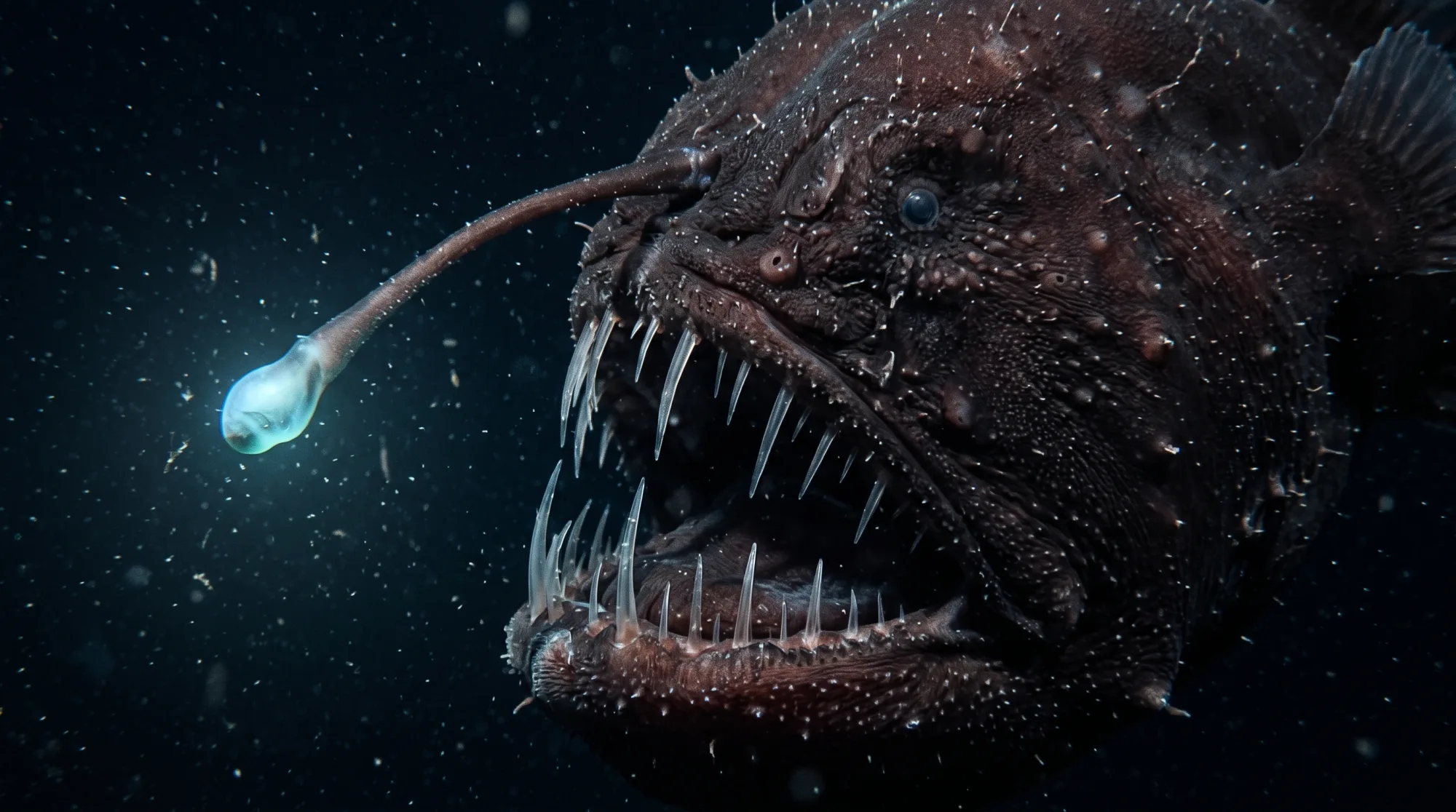
Black anglerfish with jagged teeth and a glowing lure in the deep sea

Anglerfish: quick answers

Are anglerfish dangerous to humans?

No. Deep-sea anglerfish live hundreds of metres down and most are smaller than your hand. Their teeth are a problem only for the fish and shrimp they ambush.

Is the anglerfish in “Finding Nemo” real?

Yes – it’s based on a real deep-sea anglerfish. Real ones are just much smaller than the film suggests, and the glow comes from bacteria living in the lure.

Can you eat anglerfish?

Not the deep-sea kind – they’re small and almost never caught. But monkfish, served in restaurants across Europe, is a large shallow-water anglerfish and is considered a delicacy.

Do all anglerfish live in the deep sea?

No. The anglerfish group also includes shallow-water relatives such as monkfish, frogfish and batfish. The ones with glowing lures and tiny fused males are the deep-sea anglerfish.

How big are anglerfish?

Most deep-sea anglerfish are small: many females are under 8 in (20 cm), and the males are often less than an inch. The biggest, Krøyer’s deep-sea angler, can reach about 4 ft (1.2 m).

Where do anglerfish live?

Deep-sea anglerfish live in every ocean, mostly between about 1,000 and 6,600 ft (300–2,000 m) down, where no sunlight reaches.

Know someone who needs to see this?

Send them the Anglerfish. They'll thank you. Probably.