Deep dive 3 min read
Why Does the Anglerfish Have a Light on Its Head?
In the pitch-black deep sea, the anglerfish switches on a lamp and waits. Here's how its glowing lure works, and why the light isn't really its own.
Imagine fishing in a room with the lights off. That’s life for a deep-sea anglerfish, 1,000 metres or more below the surface, where sunlight never reaches. Its solution is brilliant, literally: a glowing lamp dangling right in front of its huge, toothy mouth. But how does it work, and why does a fish need a light on its head?
A fishing rod made from a fin
The anglerfish’s “antenna” is a fin spine that has moved to the top of its head and grown long and flexible. Scientists call the rod the illicium and the glowing bulb at the tip the esca, which is simply Latin for “bait”. So if you were wondering what the anglerfish light is called, now you know: it’s an esca on an illicium. Try saying that three times fast.
The light belongs to bacteria
Here’s the twist: the anglerfish doesn’t make its own light. The esca is a little pouch full of glowing bacteria. The fish gives them a safe home and nutrients, and in return the bacteria shine. It’s a living lamp, powered by roommates.
Young anglerfish start out without bacteria and seem to pick them up from the surrounding seawater. The fish can also control the glow, for example by squeezing the bulb or changing blood flow to it, so it can flash, dim or wiggle its light like a fisherman jiggling a lure.
The anglerfish doesn’t make its own light. It rents it from bacteria.
Why a light works so well down there
In the deep sea, light means food. Most animals there produce their own glow, so a small, moving light looks like a snack worth checking out. Curious fish and shrimp swim closer to investigate. When they’re close enough, the anglerfish opens its enormous mouth and sucks them in, all in a fraction of a second.
Food is so rare that the anglerfish can’t afford to be picky. Its jaws and stomach stretch so much that it can swallow prey up to about twice its own size. The long, inward-pointing teeth make sure nothing gets out again.
Strange but trueOnly female deep-sea anglerfish have the glowing lure. The males are tiny and have a very different plan for survival, as you’ll see in our story about anglerfish love.
Other deep-sea light shows
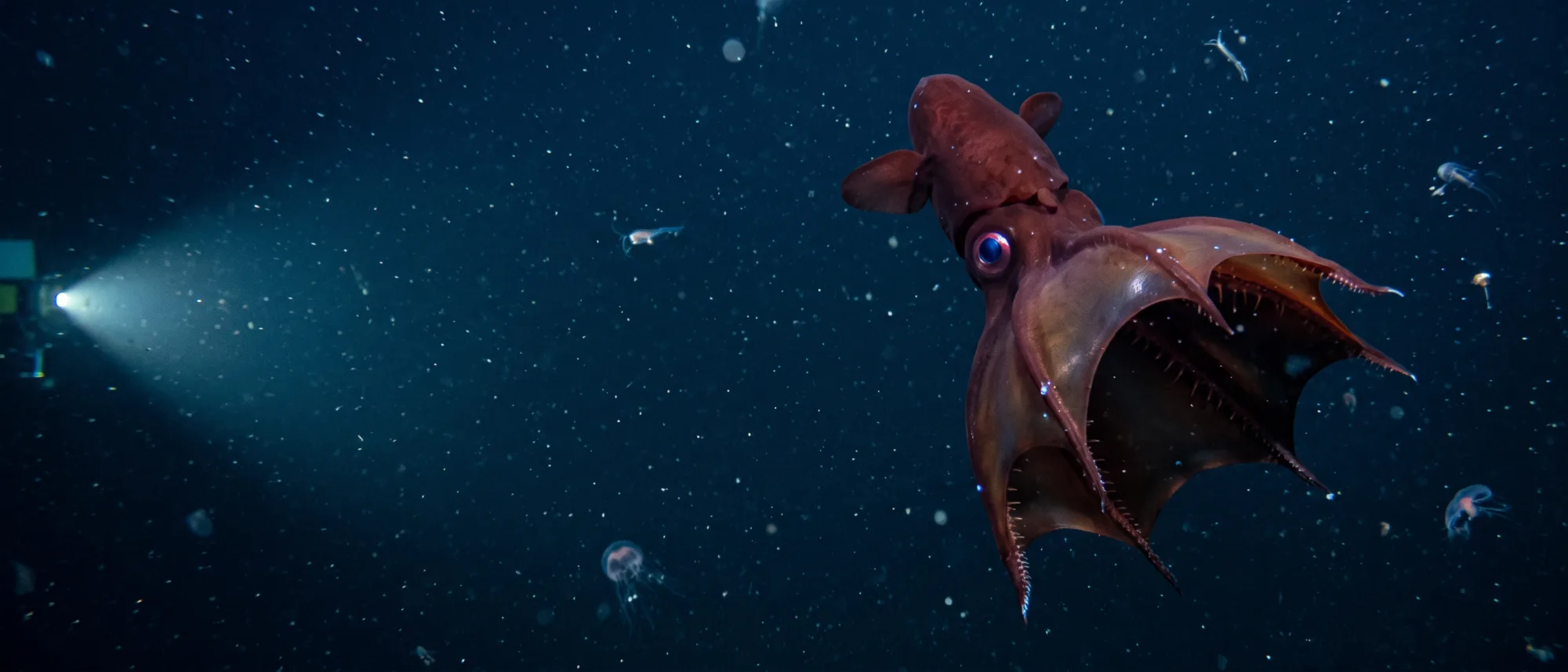
The anglerfish isn’t the only animal with lights in the dark. The vampire squid has glowing patches on its body and, when threatened, squirts out a cloud of glowing mucus to confuse attackers. The deep sea is full of creatures using light to hunt, hide and find a mate. Explore more of them in our Glow in the Dark collection.
The verdict
Why does the anglerfish have a light on its head? Because in a world of eternal night, the easiest way to catch dinner is to make dinner come to you. A fin turned into a fishing rod, bacteria turned into a lamp: evolution doesn’t get much smarter, or much creepier, than this.
Tell a friend