Deep dive 3 min read
Goblin Shark Jaws: How Its Slingshot Bite Works
Its jaws shoot out of its face like a slingshot, faster than you can blink. Here's how the goblin shark's nightmare bite works.
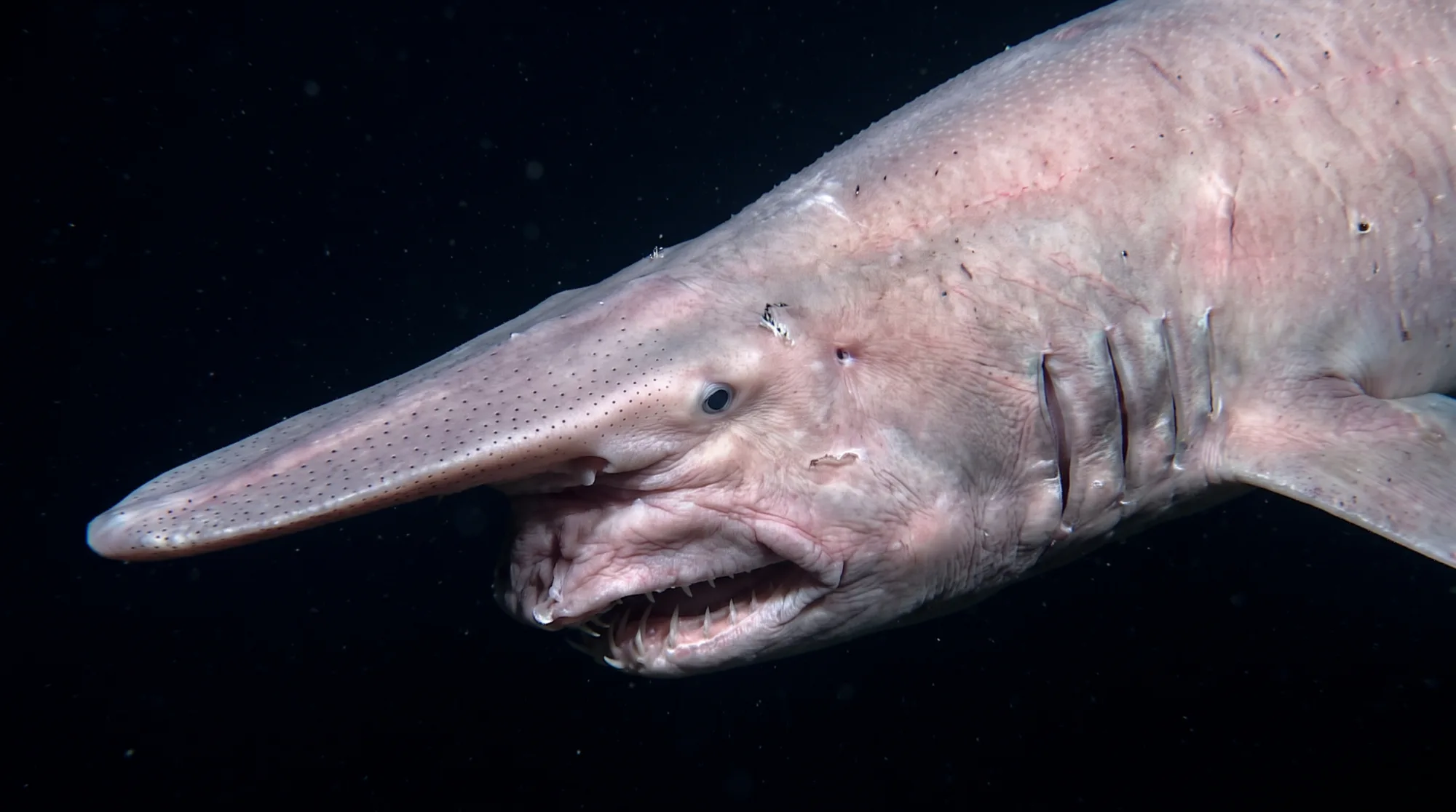
Most sharks bite. The goblin shark launches its whole mouth at you. When it attacks, its jaws shoot forward out of its face, grab the prey, then snap back into place. It looks like something from the movie Alien, and it’s one of the fastest, strangest bites in the ocean.
Meet the goblin shark
The goblin shark is a deep-sea shark with pinkish skin, a long, flat, blade-like snout and small eyes. It usually grows to about 3 to 4 metres, and there are reports of much bigger ones. It’s rarely seen alive, because it lives roughly 100 to 1,300 metres down. Its pink colour comes from blood vessels showing through its thin skin.
The slingshot bite
When the goblin shark is relaxed, its jaws are tucked neatly under its snout. But the jaws aren’t fixed to the skull the way ours are. They’re held in place by two pairs of stretchy ligaments that work like a loaded slingshot.
When prey comes close, the shark releases them. The jaws fly forward and outward in a split second, the mouth opens wide and the teeth sink in. Then the jaws pull back, dragging the prey with them.
It doesn’t lunge at its prey. It fires its mouth at it.
How fast and how far?
In 2017, Japanese scientists studied rare video of goblin sharks feeding. They found that the jaws can shoot out by about 9% of the shark’s total length. For a 3-metre shark, that’s almost 30 cm. The jaws moved at about 3 metres per second, the fastest jaw launch measured in any shark. The whole bite is over in less than a second.
Strange but trueScientists think the goblin shark’s long snout works like a metal detector. It’s covered in sensors that pick up the tiny electric fields of hidden prey.
Built for the dark
Why the extreme jaws? The goblin shark isn’t a fast swimmer. Its soft body and small fins suggest it drifts slowly through the dark, more ambush than chase. A slingshot bite lets it catch fish, squid and crustaceans without having to speed after them. Its long, thin front teeth are like nails, perfect for pinning slippery prey.
A living fossil from Japan
The goblin shark was first described from Japan in 1898. Its family goes back around 125 million years, which is why it’s often called a living fossil. Its Japanese name, tenguzame, refers to the tengu, a long-nosed goblin from Japanese folklore.
Should you be scared?
No. Goblin sharks live far too deep to meet swimmers and have never been known to attack people. They’re terrifying to look at, but harmless to us. Meet more monsters with a gentle side in our Scary but Harmless collection.
Tell a friend